NLP Definition
What is Neurolinguistic Programming?
Below you will find an NLP definition - many in fact!
What Do The Letters NLP Stand For?
The letters NLP stand for neurolinguistic programming. I am trained as an NLP practitioner so I use the term quite often. Often people look at me blankly. 'Neurolinguist programming' can sound a little daunting at first!
NLP Definition - What is NLP?
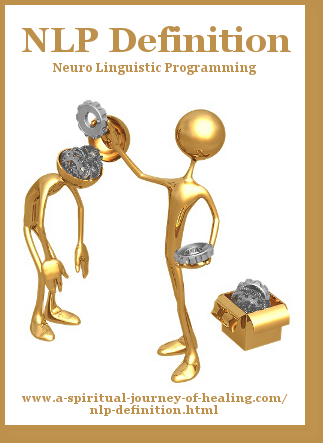
NLP suggests that we are in many ways programmed like a computer. If you can identify the programs that are running, you can also identify and apply an NLP exercise to change a program. You can then do potentially do something easily that was difficult for you before. If you like, you can install new brain software!
Another way of putting it is to ask yourself:
If you had different thoughts in your head, do you think you would feel differently about doing certain things?
If the answer is yes, then you are opening to the possibility that you can change your thoughts, change your feelings and expand the limits of what you believe you can do.
Another question...
What is the difference between yourself and someone who feels more confident and therefore finds it easier to do something or learn something than you do?
Yes, they may live in different circumstances, but do
these circumstances – past or present – perhaps result in them having an
attitude of:
I can do it.
What if you could create the same attitude?
If you believed: I can do it, what would you do that you don't do currently?
If you are asking: How can I be more confident? NLP techniques can help.
What about memories?
Is an unpleasant event still happening now?
Has the emotion attached to an unpleasant event ever lessened over time?
How much safer would you feel if you had a method to reduce the power of a negative memory?
Perhaps a memory of failure is holding you back or even keeps you awake at night. Neurolinguistic programming looks at how we store memories.
There is a simple and powerful NLP exercise to help you adapt the way you store a memory so as to give it less power over your life. The same technique can be used to give a postive memory more power, for example to raise your confidence.
Changing submodalities - NLP
Changing
submodalities is an example of an NLP exercise. For instance, you may
store a memory in colour and in a movie format. By changing it to black
and white and a still picture, you can reduce its emotional impact on
you.
If it is a positive memory, you can make it more vivid. For
example, if you are living with illness, you may want to have lots of
recent, powerful memories of being able to do the things you can't do
now, so as to influence your immune system in a positive way. (I used
The Lightning Process
to change my thoughts to change my health.)
This NLP exercise can be done alone. It is likely to be more powerful when done with an NLP practitioner or when listening to an DVD on NLP.
Other Definitions of NLP
NLP Definition:
Neuro – To do with the brain and how it works
Linguistic – We all relate to the world in different ways. The 5 main sensory languages we use are:
Visual – We use a lot of visual words eg. see, watch, look. We learn best if there is something to see.
Auditory – We use a lot of auditory words eg. I hear you, listen, loud, silent
Kinaesthetic – We speak about our feelings and the way things feel to the touch
Olfactory – We notice the way things smell
Gustatory – We notice the way things taste

This website is run by SBI.
SBI has allowed me to go from complete beginner to a website that attracts over 1000 visits a day at the time of writing, and hopefully helps many on their journey of self growth.
I am very grateful, and recommend SBI highly.
Click if you want to read about how to make your own website.
With Love,
Katherine T Owen
(author of this spirituality website)
– By thinking of ourselves as programmed, both in our youth and by the influence of the world around us, we open to the possibility that we can change our thoughts to change our life.
NLP Definition:
A technology of human performance about how you use your mind.
NLP trains you in how to change your state of mind to the desired state.
If you are not happy with how things have gone in your life up until now, know that things can change for you.
You cannot change the past, but you can change the way in which you respond to what is happening now.
By changing your response in the present moment you open to a new future.
NLP Definition:
Strategies for success in your life.
NLP Definition:
The 4 main legs of NLP:
1. Outcome orientation – be clear on your goal.
2. Sensory acuity – use your senses to notice the current situation and how it changes as you use an NLP exercise
3. Behavioural flexibility – be willing to change your behaviour. Use NLP techniques to influence your mind or emotions in the knowledge that this will then allow new behaviours to become available to you.
4. Building rapport. Notice the way someone speaks and their body language.
Allow
them to feel relaxed with you by speaking in the same way and using
some of the same body language. Sometimes this one of the legs or
pillars of NLP is missed out.
NLP Is A Flexible Therapy
NLP is not a rigid set of techniques. NLP takes the view: "if it works, try it".
If
an NLP exercise doesn't work for you (or for your client), you would be
encouraged to try another or develop another, or see what is working
for someone else and learn that.
NLP techniques constantly evolve and are added to.
This is just a very small introductory NLP explanation.
With my love, and every good wish on your journey,
Katherine
Katherine T Owen, webmaster,
Author of Be Loved, Beloved (Kindle)
Related Articles -NLP Definition
Psychology Religion Spirituality - how the same, how different?
On a path of self growth, many of us explore psychology religion spirituality –approaches to how to be happy and have a good relationship with self. How are they the same, how different?
A List of Family Roles From Family Systems Therapy – Help with Illness
Family system roles. A list of family roles in family systems therapy helps explain why families deny illness and how to cope. Psychology self help books, therapy, healing.
Psychology Self Help– John Bradshaw Psychology Books (Family Systems)
The psychology books of John Bradshaw led me on a journey of psychology self help. In severe illness I needed skills to adapt within the family system. Book review on The Family, Homecoming...


- Can we change thoughts to change health?
- For many years I was severely disabled, unable to stand or have a normal conversation. Read about my Recovery from severe ME through the Lightning Process
- Positive self talk is a powerful way to train the brain to think new thoughts.
- Our identity is often programmed by the psychology of family relationships we established in our childhood. Awareness of family roles can help us re-define ourselves.
Or Click below to move from NLP definition to the home page - A Practical Spirituality
- Home page
- NLP Change & Healing
Receive daily inspiration...
Receive daily inspiration by putting
your favorite (favourite) quote on
an item you see daily around your home-
a mug, cushion, postcard, coaster, T shirt etc.
You will find my zazzle gift store at
zazzle.com/HealingStore (USA)
Use one of my designs or start from a blank.
zazzle.co.uk/HealingStore (UK)
Thank you so much for supporting this website
www.a-spiritual-journey-of-healing.com
Katherine


My name is Katherine Owen.
Please respect my copyright as the author of this website.
I am delighted if you choose to share on social media, but please do NOT reproduce any of the contents of this page without permission.
© Katherine T Owen


To receive
Releasing Judgment,
a FREE ebook
or to keep in touch...
Please be assured - I will NOT pass on your e-mail address to anyone else.
Be Loved
Beloved
15 Spiritual Love Poems
God Love Self Love
(by the author of a-spiritual-journey-of-healing.com)
For 14 years, Katherine T Owen was severely disabled with Myalgic Encephalomyelitis, unable to walk, with little speech, and with inadequate care.
Katherine's small beautiful collection of poems take the reader with her as she journeys to know both self love and
God's love.

If you don't have a kindle, you can download FREE software to read the kindle book on your computer.

Click to preview or BUY
the PAPERBACK of
Be Loved Beloved
"One thing that struck me was the stripping of ego in the work. Most of us have a comfy ego façade, but weakness and disease tore Katherine’s away. The poems in Be Loved Beloved come from the heart."
Dana Taylor, Author of Ever-Flowing Streams: Tapping into Healing Energy
What's New?

-
Psalm 91 Prayer For Protection In Hard Times
 I prayed the Psalm 91 prayer for protection in hard times, for strength. Words of. Interpretation. What is the meaning of this psalm? Adapted version.
 -
Jesus Christ Crucifixion Poem– Crown of thorns, Carrying the cross
 Easter Jesus.powerful poem. Scourging at the pillar, crown of thorns. Jesus carries the cross. Jesus Christ crucifixion. Based on St Matthew’s gospel.


