- Home
- A Christian mystic
- Christian Mysticism in Britain
Christian Mysticism in Britain
Christian mysticism in Britain is a tradition shaped by saints, hermits, poets, and ordinary believers who have found God in solitude, nature, and the hidden life.
The words of the Bible come alive in the lived experience of the ordinary, in the spaces between the words, and through hearing God's voice in art, in poetry, and through seeing the Christ in the next person met along the way.

I identify as a modern day Christian mystic in Britain. On this page, I trace the lineage, from the early Celtic saints to the contemplative writers of medieval England, and through the profound shifts brought by the Reformation.
To receive Releasing Judgment, a FREE ebook
or just to keep in touch, sign in below.
Your email will definitely not be misused
and you can unsubscribe at any time.
With love, Katherine
Contents
Scroll down or click on the link when given.
- The Christian Mysticism of St Patrick
- The Christian Mysticism of St David
- Finding God in Nature: The Celtic Mystical Way
- A prayer celebrating God in nature - Prayer at Sheepscombe
- Finding God in Silence: Monasteries And Hermits in Britain
- Finding God in Silence: Anchorites in Britain
- Augustine of Canterbury and the Pre Roman Christian Mysticism of Britain
- Marian Devotion in Britain: A Mystical Tradition
- Female Christian Mysticism in Britain and Ireland
- St Brigid of Kildare
- Hilda of Whitby
- Julian of Norwich
- Margery Kempe
- The Cloud of Unknowing: England’s Mystical Classic
- The Reformation and the Loss of Christian Mysticism in Britain
- Quaker Mysticism
- Closing Reflection
Christian Mysticism in Britain: An Introduction
Christian mysticism in Britain is a tapestry woven from Celtic spirituality, monastic silence, Marian devotion, visionary experience, and the contemplative writings that emerged from the medieval period.
From the earliest centuries, Britain developed its own Christian identity — one that was not initially shaped by Rome but by local saints, wandering monks, and communities who prayed in small stone cells on windswept hills. This mysticism was earthy, embodied, and deeply relational. It found God in rivers, mountains, and the quiet of the human heart.
 Photo of Glastonbury Tor by my friend, the poet, Jay Ramsay, rest in peace
The Christian Mysticism of St Patrick
Although Patrick is often associated with Ireland, his roots lie in Britain.
Patrick was born in Roman Britain, captured by the Irish and worked in Ireland as a slave. His spirituality was shaped by his captivity, by solitude and long hours spent tending sheep in silence. In that silence, he discovered a God who was immediate and sustaining.
He escaped back to Britain. But heard the voice of Ireland calling him and returned as a missionary.
Patrick’s writings reveal a mystic who experienced God as a living presence. His prayers speak of Christ surrounding him — before, behind, above, within.
This sense of divine immanence is characteristic of Celtic mysticism: God not as distant ruler but as intimate companion.
Move here to read the prayer of St Patrick.
Patrick reminds us that mysticism often begins in hardship. His contemplative awareness grew under the sky, with only silence and suffering as teachers.
The Christian Mysticism of St David
St David of Wales embodies another strand of British mysticism: simplicity, asceticism, and the holiness of everyday life.
David taught his followers to “be joyful, keep the faith, and do the little things.”
This captures the heart of Welsh spirituality — a mysticism grounded in small acts of devotion.
David’s monasteries were places of silence, manual labour, and prayer. The monks drank only water, ate only bread and herbs, and spent long hours in contemplation. This was not austerity for its own sake but a way of clearing space for God.
David’s mysticism is gentle and practical. It teaches that God is found not in dramatic visions but in the quiet fidelity of daily life. His influence shaped Welsh Christianity for centuries, creating a culture where contemplation and simplicity were honoured.
Finding God in Nature: The Celtic Mystical Way
One of the most distinctive features of Christian mysticism in Britain is its relationship with nature.
The weaving of nature and Christianity is not unique to Britain, but Britain has expressed it in a particularly distinct way.
Missionaries wove Christian teaching into the existing nature‑centred practices of the local pagan culture — honouring sacred groves, wells, stones, and seasonal festivals. This allowed the new Christian faith to feel continuous with what people already knew.
The blending of paganism and Christianity is still visible today in the Green Men carved into Norwich Cathedral and in other pagan symbols quietly preserved in British churches.
Celtic Christianity saw the natural world as a “second scripture” — a place where God’s presence could be felt directly.
This tradition speaks of “thin places,” locations where the veil between heaven and earth feels especially delicate. Mountains, rivers, forests, and islands became sites of prayer and pilgrimage. The early saints built their hermitages in remote places not to escape the world but to encounter God more fully within it.
Nature mysticism in Britain is rooted in the belief that creation is infused with divine life. The wind, the sea, the stones, the animals — all are part of the sacred conversation. This way of seeing shaped the spirituality of Patrick, David, Brigid, and many unnamed hermits whose lives were spent in quiet communion with the land.
Today, many people are reclaiming this way of finding God in nature and silence, often under the name of Celtic Spirituality.
Twenty minutes from me, at Avebury, St James Church holds Celtic Christian services.
I am a non duality Christian. I see the physical world of change as an illusion, and God's world of the eternal as reality. I also claim the workbook lesson 30 of A Course In Miracles, God is in everything I see.
Like many I find it easy to find God in the natural world.
I love the hymn, The love of my Lord is the essence of all that I love here on earth.
Move here to read poems about God in nature.
A prayer celebrating God in nature - Prayer at Sheepscombe

Spirit of the wind
Breathe down over these valleys,
Spirit of the air
Breathe in our blood
Spirit of the water
Cleanse our eyes
Spirit of the earth
Warm our feet,
Spirit of Fire
Penetrate our hearts –
Spirit of Fire
Enter our minds –
Spirit of Fire
Strengthen our seeing –
That we may walk in truth
On Your Living Ground.
by poet, Jay Ramsay
Finding God in Silence: Monasteries and hermits in Britain
A tradition of silence created a lineage of mystics who understood that God is often found not in noise or activity but in stillness.
Silence has always been central to Christian mysticism in Britain. From the earliest centuries, monks and hermits sought solitude as a way of listening more deeply to God.
British monasteries — from Iona to Lindisfarne, from Whitby to Glastonbury — were centres of prayer, study, and contemplation. Their rhythm of life was simple: work, silence, scripture, and communal worship. These communities preserved not only Christian teaching but also the contemplative practices that shaped British spirituality.

Glastonbury — with its ancient abbey, its Christian legends of Joseph of Arimathea, and the tradition of pilgrimage to the top of the
Tor — sings with the themes of British Christian mysticism.
In Britain, Catholicism was an illegal and persecuted religion for many centuries. Catholic Emancipation dates from 1829, but public Catholic ritual was still restricted.
The first large scale Catholic event since the 16th century was the Catholic pilgrimage to Glastonbury on 12 September 1895.
In 1924 the annual Catholic pilgrimage became an annual event, and has now taken place for over a century.
Finding God in Silence: Anchorites in Britain
Anchorites were individuals who chose to live enclosed in small cells attached to churches. Julian of Norwich is the most famous example.
Anchorites lived in profound silence, dedicating their lives to prayer and spiritual counsel. Their solitude was not isolation but a radical form of availability to God.
Augustine of Canterbury and the Pre‑Roman Christian Mysticism of Britain
When Augustine arrived in Britain in 597, he found a Christian tradition already flourishing — one that had not come from Rome but from local saints and Celtic missionaries. This indigenous British Christianity was contemplative, monastic, and deeply mystical.
The Celtic Church emphasised the following:
- personal holiness;
- nature as a place of encounter;
- small monastic communities;
- direct experience of God;
- a rhythm of prayer woven into daily life.
Augustine’s arrival brought Roman structure, liturgy, and hierarchy, but the mystical heart of British Christianity remained. The meeting of these two traditions created a unique blend: Roman order infused with Celtic contemplation.
Marian Devotion in Britain: A Mystical Tradition
Marian devotion has long been part of Christian mysticism in Britain. Mary represents openness, surrender, and the willingness to say yes to God. These qualities are central to mystical life.
Marian devotion can be seen as a form of Christian mysticism because it invites the believer into a relationship of tenderness, trust, and inner receptivity. Mary becomes a model of the contemplative path — one who listens deeply and responds with courage.
Walsingham, Britain’s most famous Marian shrine, was a centre of pilgrimage for centuries. Henry VIII, who later severed Britain from Catholic Christianity, visited Walsingham with devotion. He reportedly walked the Holy Mile barefoot. Marian mysticism was woven deeply into British spiritual life.
Devotion to Mary was also a strong thread in the mythical story of King Arthur. Medieval writers describe Arthur’s shield, Pridwen, as bearing an image of the Virgin Mary.
Marian devotion offers a way of encountering God through love rather than fear, through surrender rather than striving. It remains a cherished part of Catholic Christianity and is increasingly appreciated by those exploring contemplative spirituality today.
Walsingham was destroyed. But was rebuilt and is a place of pilgrimage to ask for prayer from Mary for both Catholics and Protestants.
Move here for the Hail Mary Prayer.
I’ve written a short reflection on a simple stone mosaic — a circle‑cross symbol photographed in Glastonbury — and its meaning within Christian mysticism.
Read more: A Christian Mystical Symbol in Glastonbury
Female Christian Mysticism in Britain and Ireland
Britain and Ireland have a rich lineage of female mystics. Christian mysticism in Britain has always included strong female voices — voices of courage, insight, and deep intimacy with God.
St Brigid of Kildare
Not British, but Irish, born in Leinster.
Brigid founded her great monastery at Kildare. An Irish woman of immense spiritual authority, she embodied generosity, healing, and the sacredness of everyday life. Her miracles and compassion reveal a mysticism rooted in hospitality and divine presence.
Hilda of Whitby
Whitby.
A leader, teacher, and contemplative, Hilda guided monks and nuns alike. Her monastery was a centre of learning and spiritual wisdom.
Julian of Norwich
Norwich.
One of the greatest mystics in Christian history, Julian’s visions of divine love continue to inspire readers worldwide. Her teaching on “oneing” — the soul’s union with God — is a profound expression of non‑dual Christian mysticism.
Julian of Norwich is most famous for a line that Christ gave to her:
“All shall be well, and all shall be well, and all manner of thing shall be well.”

Margery Kempe
King’s Lynn, Norfolk (East Anglia). Controversial yet deeply devout, Margery’s emotional, visionary spirituality shows the diversity of mystical experience in medieval Britain.
The Cloud of Unknowing: England’s Mystical Classic
Written in the late 14th century, The Cloud of Unknowing is the most influential work of Christian mysticism in Britain. Its anonymous author teaches that God cannot be grasped by thought but only by love.
The book invites the reader to “forget” everything that is not God — to enter a cloud of unknowing where the mind rests and the heart reaches out in longing. This is pure contemplation, a path of surrender rather than analysis.
The Cloud stands alongside Julian of Norwich as one of the great treasures of English spirituality. Its teaching resonates with modern seekers who long for a direct, experiential relationship with the divine.

The Reformation and the Loss of Christian Mysticism in Britain
The British Reformation brought profound change to Christian mysticism in Britain. Initiated by Henry VIII for political reasons, it was the origin story of Anglicanism and Protestantism.
The Protestant emphasis on finding God in the powerful words of scripture, led many mystical elements of Christianity to be set aside– ritual, chant, silence, nature spirituality, Marian devotion, monastic life, contemplative prayer
Some Protestant communities have since reclaimed elements of contemplation, but the Reformation marked a significant shift away from the mystical heart of British Christianity.
As I’m presenting Catholicism as the more mystical denomination in Britain, it seems relevant to give a brief summary of how Britain has regarded Catholicism since the time of the Reformation.
In Britain being Catholic was made an act of treason by Henry VIII. Later monarchs fined and taxed their subjects for not attending Anglican worship.
In 1829 the Roman Catholic Relief Act allowed Catholics to vote and to sit in Parliament, removing most civil restrictions.
Since the Reformation, the Catholic Church in Britain has largely been an immigrant church. Immigration has now taken place over a sufficiently long time for Catholicism to have become a significant presence in Britain once again. Catholic Christian mysticism is once more part of our islands.
Thankfully we live in a time in Britain when religion is no longer imposed.
Many of my Protestant friends find richness in Celtic spirituality, monastic retreats, the nature-focused Christianity of St Francis, the practice of the presence of Brother Lawrence, and the contemplative writings of Catholics such as Henri Nouwen and Richard Rohr.
Quaker Mysticism (17th century)
Distinct from monastic and medieval traditions, early Quakers represent a major movement in Christian mysticism in Britain.
George Fox (1624–1691) taught that the Inner Light of Christ guides each person directly, without ritual or hierarchy.
This experiential, inward approach places Quaker spirituality within the Christian mystical lineage.
Quakerism:
- originated in Britain
- flourished in Britain
- shaped British religious culture
- produced a major mystical movement within Christianity
Closing Reflection
Christian mysticism in Britain is a story of silence, landscape, courage, and the quiet pursuit of God.
It is found in the fields where Patrick prayed, in the monasteries where David taught simplicity, in the hermit cells of Julian, on the islands of Iona and Lindisfarne, in the Marian shrines of medieval pilgrims, and in the pages of The Cloud of Unknowing.
It is a tradition shaped by both continuity and disruption, by the gentle persistence of those who sought God directly.
Today, mysticism is often associated with spirituality outside of Christianity, yet for many of us the two belong together. Christian mysticism in Britain continues quietly, carried by those across all denominations who find God in solitude, in nature, in poetry, and in the hidden places of the heart.
Articles related to Christian Mysticism in Britain
Click here for my personal journey with Christian Mysticism in a time of solitude, and illness.
Click for a short article on Catholic spirituality. Includes quotes from a TV program documenting five ordinary men living in the Big Silence of a monastery. And quotes on Christianity and awakening by Anthony de Mello.
Christian Mystic in England today- solitude, illness, poetry, oneness
A personal journey as a Christian mystic in England — solitude, illness, poetry, and awakening to God’s presence through contemplative spirituality.
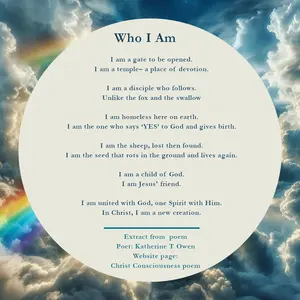
Christ Consciousness Poem, also Christian Mystic, Non Duality
A Christ consciousness poem also expressing Christian mysticism and Christian non duality. Explore identity in God, inner awakening, and the birth of Christ within.
A Christian mystical symbol in Glastonbury– Celtic roots
A simple Christian mystical symbol in Glastonbury– its meaning, its Celtic roots, and a personal reflection on friendship, pilgrimage, and quiet faith.



Thank you for reading this article.
And thank you for being here.
With the Love we are,
Katherine
Katherine T Owen, webmaster at
www.a-spiritual-journey-of-healing.com
Author of Be Loved, Beloved (£1 or $1 approx on Kindle)
Owner of the zazzle HealingStore for delightful customized gifts.
Receive daily inspiration by putting
your favorite (favourite) quote on
an item you see daily around your home-
a mug, cushion, postcard, coaster, T shirt etc.
You will find my zazzle gift store at
zazzle.com/HealingStore (USA)
Use one of my designs or start from a blank.
zazzle.co.uk/HealingStore (UK)
Thank you so much for supporting this website
www.a-spiritual-journey-of-healing.com
Katherine


My name is Katherine Owen.
Please respect my copyright as the author of this website.
I am delighted if you choose to share on social media, but please do NOT reproduce any of the contents of this page without permission.
© Katherine T Owen
Recent Articles


-
How To Forgive Someone Who Has Invaded Your Space
Sep 09, 26 12:57 PM
 A spiritual solution to how to forgive someone who has invaded your space. Release judgment, reclaim peace, and find healing through inner transformation.
 -
How to Forgive a Bully - A Spiritual Approach to Healing
Sep 07, 26 04:18 AM
 A spiritual guide on how to forgive a bully. Release judgment, find moments of peace, and heal from bullying through a gentle inner practice. Well tested.
 -
Poems About Illness and Healing — poet Katherine Owen
Sep 02, 26 03:08 PM
Poems about illness and healing, learning and change — honest, compassionate reflections from Katherine Owen on living through difficulty and finding resilience.